Picketing the New National Theater, Minneapolis, in 1917.
Location: Minneapolis
Blue Mouse Theater, Hennepin Avenue between Seventh and Eighth Streets, Minneapolis
Blue Mouse Theater, Hennepin Avenue between Seventh and Eighth Streets, Minneapolis.
Boy looking at movie playbills in theater lobby
Liberty Theater, North 6th and Lyndale Avenue North, Minneapolis, Minnesota
Pantages Theater, 708 Hennepin, Minneapolis
Lyceum Theater, 85 South Eleventh, Minneapolis
Lyceum Theater, 85 South Eleventh, Minneapolis.
Stagehands at the Shubert Theater, Minneapolis
Ritz Theater, Minneapolis
Interior of State Theater, Minneapolis.
State Crowd in 1920s
Loring Theater, 1405 Nicollet, Minneapolis
State Theatre in 1923
State Theater ushers taking a break
Production at State Theater
Production at State Theater.
People lined up outside the Garrick Theater, Minneapolis
Red Top cab in front of Hennepin–Orpheum Theater
New Garrick Theater, 40 South Seventh Street, Minneapolis
Lyceum Theatre, Minneapolis
Lyceum Theatre, 82 S. Eleventh Street, Minneapolis.
State Theater ushers
Homewood Theater, Minneapolis, Minnesota
Bomb Discovered
Minneapolis, Oct. 13.
A bomb plot to blow up the Wonderland, picture house, was uncovered when five sticks of dynamite were found in the box office.
The bomb plot, laid at the door of radicals, was discovered by Edward Oliver, manager.
Five years ago the theatre was a storm center in the labor dispute which sent four officials of the Trades and Labor Assembly to jail and resulted in a court order restraining picketing of the show house for running on a non-union basis.
The Wonderland had closed for the night and it was an accident the bomb was found by Oliver. It had been pushed through a small opening in the box-office window.
View of a hallway in the Suburban World Theater, Minneapolis
View of the auditorium of the Suburban World Theater, Minneapolis
View of the auditorium of the Suburban World Theater, Minneapolis, Minnesota, taken from above. This theater was also known as the Granada Theater. Liebenberg and Kaplan, Architects (1919-1969), were noted for designing more than 200 motion picture theatres in the Upper Midwest, many of the early ones featuring an art deco style.
Aerial View of Downtown Minneapolis Looking North Towards the Broadway Bridge
AERIAL VIEW OF DOWNTOWN MINNEAPOLIS LOOKING NORTH TOWARDS THE BROADWAY BRIDGE
Orchestras Go Out of F. & R. Theatres
Minneapolis, July 5.
Taking their cue from the producers who are talking about slashing overheads, Finkelstein & Ruben, exhibitors, have started paring expenses wherever they feel that the knife can be applied.
As the first step, they have eliminated orchestras during week days in the four Twin City houses which boast this feature. In the case of the local State theatre, their ace house, having an 18-piece orchestra, the saving amounts to over $100 a day and $500 on the week. A similar saving is effected at the Capitol, St. Paul. The orchestras are on the job Saturday and Sunday afternoons the same as at night.
The present plan is to continue the non-orchestra week-day matinees only during the summer month, but if patrons are as satisfied in the weeks to come as they have been during the past fortnight, and if satisfactory arrangements can be made with the musicians’ union, it is believed in local theatrical circles that the proposition will be made permanent.
Admission at the State and Capital is 60 cents at nights, 50 cents at Saturday and Sunday matinees and 35 cents at week-day afternoons. Both houses have Vitaphone installastions, the finest of organs and splendid organists. On the whole, week-day matinee business in this city is very slim. At the State during the past two weeks, however, due to exceptional box office attractions (kiddies’ revue and the Minneapolis movie) the afternoon trade has been heavy, running close to capacity for the most part. Patrons at these matinees apparently have not missed the orchestra and there have been no complaints. The organ and the Vitaphone appear to be supplying all the music desired. An electric piano attachment to the organ varies the music.
As far as the State, at least, is concerned, there has been no necessity for retrenchment. During the past season this house has done the biggest business in its history and has made a mint of money for Finkelstein & Ruben. The summer has not brought any let-down. If anything, grosses are running higher than ever.
The house has a splendid cooling plant and even last week, when temperatures went as high as 36, trade was brisk both matinees and nights—this without the orchestra at the matinees.
Another Minneapolis Suburban?
Minneapolis — William’ Berg is planning an 800-seat theater at 3020 Hennepin Ave., one block from the Lagoon, one of the “ace” suburban houses of Northwest Theaters (Finkelstein & Reuben). The proposed theater would cost $100,000, but some difficulty is anticipated on granting of the license, it is stated.
Last-Minute Hitches Block Pooling of F. & R. and Saxe
Minneapolis — Last minute hitches have caused postponement and possibly abandonment of proposed pooling of the Northwest Theaters (Finkelstein & Ruben) Minneapolis, and Saxe Enterprises, Milwaukee, circuits. Now other large circuits again are said to be angling for the F. & R. chain of around theaters in Minnesota, North and South Dakota and Wisconsin. There are approximately 45 houses in the Saxe chain, which is confined to Wisconsin.
John Saxe is declared to have balked at several angles of the proposed pool, which would have given F. & R. at least operating control of the combined firm, in what was declared to be the forerunner of a move to bring both circuits into the West Coast chain.
Publix and Universal, which are declared to have made overtures in the past, are said to be again active in seeking a deal with F. & R.
While those “in the know” declared that all negotiations were off, it was, nevertheless, significant that John Saxe was in Minneapolis several days the past week and although he stated that his visit here was in the interest of other business, he was said to have been in several lengthy conferences with officials of the F. & R. circuits. “Greater Amusements” says in commenting on the situation.
“Publix would, of course, welcome some kind of working arrangement with F. & R. to offset any loss that may be sustained by the Paramount distributing organization in the Northwest due to the erection of the new Publix house in Minneapolis, which will eventually cause a break between the Minneapolis firm and Paramount in the booking of the latter’s product in other F. & R. strongholds throughout the Northwest,” the publication states. “It is said that Paramount has already felt the sting of F. & R.’s resentment throughout the territory in retaliation for the invasion of Minneapolis, by Publix.
“Universal would naturally hold out the olive branch of both F. & R. and Saxe as a tie-in would materially strengthen that company’s theater position in the Middle West territory. In Wisconsin, Universal is operating in direct opposition to the Saxe circuit in nearly every spot in which it has a theater. An arrangement in the F. & R. field would also assure Universal more product than it now enjoys.
“It is possible that the real reason for the calling of? of the meeting said to have been scheduled for New York City last Monday was caused by the decision of the Federal Trade Commission, which would naturally cause a slowing up of any proposed theater pools. While the decision was rendered in the case against Paramount, it consequently affects all companies in a similar manner.”
F. &. R. Move Against Invasion
Minneapolis — With a permit for an 800-seat theater at 3020 Hennepin Ave., granted to William Berg, Northwest Theaters (Finkelstein & Ruben) plans to reconvert the Calhoun Terrace, nearby ballroom, into a theater, seating 1,300. The move may forestall erection of the house by Berg, who would be “sandwiched” between the Calhoun Terrace and Lagoon.
Movie Operators Strike
Special to the New York Times.
CHICAGO, August 23.—Moving picture operators called a strike at the Belmont Theatre today, and by night it had spread to other theatres of the Orpheum Circuit. The walk-out of the operators did not affect the other theatre employes and the vaudeville performances proceeded as usual.
The operators said the Belmont Theatre had sought to dispense with the services of two of its four operators, claiming that, because of the five acts of vaudeville, there was no need of two operators on each of two shifts. The unionists then walked out and within a short time a sympathetic strike was in progress.
Labor Troubles Threaten
WITH present contracts expiring August 31st, labor troubles again loom as a great menace to exhibitors in many parts of the United States. It is feared in some quarters that there is such a variance between amounts asked by union workers and those set by the exhibitors that there are bound to be a number of walkouts.
Conditions have changed during the past year, according to many of the exhibitors and if the unions insist upon increases a large number of houses will be either forced to close or do without ‘musicians or union labor help. In some places exhibitors are oven demanding that the union men accept a reduction in wages.
In the Twin Cities the unions are declared to be on the defensive with the theatres insisting upon a reduction in wages because of poor business caused by a general slump. The exhibitor unit is conferring with musicians, operators and stage hands in an effort to induce them that a cut is imperative if theatres are to continue to operate with union labor.
The agreement in Seattle between musicians, stage hands and operators and the exhibitors expires September 1st. Wage increases are demanded from all quarters and a lively fight is anticipated. Another demand is for the retention of the present existing minimum labor rule, where the number of employees is determined by seating capacity.
In Washington, D. C, the demand of the musicians is for a 20 per cent increase, bringing the scale from $67 to $85 a week. A series of meetings have been held between the theatre owners and musicians and the owners have declared emphatically they will not meet the new demands. Every effort is being made, however, to defer a strike.
The threatened silence of the thirty-five neighborhood motion picture theatres controlled by members of the St. Louis Motion Picture Exhibitors League has been averted through an agreement reached by the theatre owners with officials of the Musicians’ Union for a reduction in the orchestral personnel of the theatre. The arrangement finally reached is a compromise of the original demand of the theatre owners, who asked for lower wages, a reduction in orchestras and an extension of the Summer season for two weeks, or until September 1.
Under the new plan the orchestras of all the theatres having 850 seats or less will be reduced one man each. Theatres in the 850-seat class will have orchestras of three pieces instead of four, and those with 500 seats or less can be operated with a pianist instead of two pieces of music.
The Summer season is also extended for the two weeks closing on September 1 instead of August 15 as fonnerly. Houses that rate more than 850 seats are not atfected by the new agreement with the Musicians Union.
Movie Operators Demand Pay Rise
Unless motion picture machine operators and theater owners of Minneapolis negotiate a new wage scale by Wednesday night, the city will be without motion pictures Thursday, spokemen for the operators’ union said today.
The present wage agreement between the Motion Picture Machine Operators Union and the Motion Picture Theater Owners Association will expire at midnight, August 31, and the operators have served notice that unless they are granted increases in pay, they will strike September 1.
No question caused by the strike of motion picture machine operators in Chicago is involved in the dispute here, Joseph Elwood, business represetnative of the union in Minneapolis, said today.
“No action on the Chicago strike situation will be taken here unless the owners there should decide to try to break the strike by employment of nonunion men,” Mr. Elwood said. “If that situation should arise, we probably would be instructed by the international office to take some sympathetic action.”
Negotiations between the theater owners and the operators have been under way for 30 days with no agreement reached or any arrangements make [sic] for a meeting to iron out differences, according to Mr. Elwood.
There are about 70 operators in Minneapolis who are members of the union. They are employed by 58 motion picture houses. Only one theater in the city employs a non-union operator.
The present wage scale ranges from one dollar to one dollar and forty cents an hour, depending on the class of theater in which the worker is employed. Average number of hours worked is six and a half a day.
It is expected that a meeting the men and the theater owners will be called today or Wednesday in an effort to conclude a new agreement. The agreement now effective was made two years ago.
Theater Strike as in Chicago Feared Here
The possiblity of a theater strike in the Twin Cities and the Northwest, similar to that in Chicago which has left that city without amusements for two days, was feared today as local and national officials of the Musicans, Stagehands and Motion Picture Operators unions prepared to meet this afternoon with officers of the Northwest Theater Owners and Managers association in Minneapolis.
May Involve Others.
Recent announcement that a certain St. Paul theater was to be operated without an orchestra after September 1, resulted in conferences extending over several days. The protest of the Musicians’ union, it is learned, may involve the stagehands and film operators.
National offices of the three unions have been in the Twin Cities for the past week, it is said, and the meeting this afternoon at the Nicollet hotel will determine whether the musicians will walk out. Such a walkout, it is believe in union circles, would cause a sympathetic movement on the part of the stagehands and film operators.
Demand Orchestra Be Kept.
The musicians, it is understood are not asking for any increase in pay. They are demanding only that the orchestra be retained in the St. Paul theater.
Officials of all three unions appeared optimistic concerning the outcome of the meeting today.
Roy W. Moore, business representative of the moving picture machine operators of St. Paul, state today that so far as the operators in this city are concerned, satisfactory wage contracts have been completed with the theater owners.
Movie Machine Operators Do Not Foresee Trouble
Announcement that contract negotiations between motion picture operators and owners of St. Paul theaters ahve been adjusted satisfactorily and that no participation in trouble growing out of strained relations between the theater owners and musicians is anticipated by the operators, was made Wednesday night by Ray W. Moor, business representative of the St. Paul Machine Operators local No. 356.
“Negotiations for new contracts have been in progress for some time and new contracts between the St. Paul Moving Picture operators and the motion picture theater owners of St. Paul were settled some time ago in a manner satisfactory to both parties concerned,” Mr. Moor said.
Doesn’t Anticipate Trouble.
“I therefore wish to inform the public that I do not anticipate any trouble at this time as far as the operators of St. Paul are concerned.”
Musicians and theater owners of the Twin Cities are attempting to reach an agreement over ill feeling aroused by announcement by the owners that one St. Paul theater would operator without an orchestra after September 1. The musicians’ union is protesting the discharge of members of this orchestra.
Chicago Strike Spreads.
The movie theater lockout in Chicago on its third day, spread to houses that have been open, as machine operators prepared to seek an injunction against distributors who have refused to supply films, an Associated Press dispatch announced.
The Minneapolis motion picture operators branch of the International Alliance of Theater Stage Employes informed the theater owners of the city Wednesday night that they would walk out and strike unless their demands for wage increases and better working conditions were met before midnight, tonight.
St. Paul Theater Closed to Halt Musicians Row
58 Mill City Playhouses May Shut Doors Tonight
Tieup to Take Place Unless Owners Answer Movie Operators Ultimatum Satisfactorily Today.
Because of disputes between theater owners and labor organizations in the Twin Cities, the Astor theater in St. Paul will close its door Friday night, and unless a compromise can be brought about today 53 theaters in Minneapolis will close down at midnight tonight.
Because of a threatened walkout of musicians, unless the orchestra is kept employed while the theater is open, the Astor theater will close indefinitely, Finkelstein & Ruben officials announced.
Meeting in Minneapolis Wednesday afternoon with officials of the Theater Owners’ and Managers’ association, representative of the St. Paul Musicians’ association and their national union officers negotiated a contract the terms of which included references to the Astor and the maintenance of the orchestra there.
No Fear for St. Paul.
Harold Finkelstein today made the following statement on behalf of Finkelstein & Ruben regarding the situation:
“Labor negotiations involve no difficulties in St. Paul. The operators’ agreement was reached some time ago, and the musicians’ association and the managers settled on a contract Wednesday. A dispute arose in regard to the Astor theater, which was disposed of by the closing of the theater.
“A rather tense situations has developed in regard to the operators in Minneapolis, but we hope that the two negotiations committees will be in accord before the time designated as a breaking point.”
In Minneapolis the strike of motion picture operators which threatens 58 theaters will take effect after midnight tonight unless theater owners today satisfactorily answer an ultimatum issued by the operators early this morning.
Would Make 6,000 Idle.
Closing of the Minneapolis houses would throw out of work between 6,000 and 7,000 persons, it is estimated.
The strike threat followed a three-hour conference at the Nicollet hotel in which owners and union operators failed to come to an agreement on the latter’s demands for wage increases and better working conditions.
The Minneapolis Motion Picture Theater Operators’ association is a branch of the International Alliance of Theater Stage Employes.
With their present wage scale agreement which has been in extence for the past two years expiring at midnight, the operators went to the conference demanding increases ranging from 10 to 8 per cent. The increases demanded are on the existing scale which are from $1 to $1.45 an hour for a 6-hour day.
St. Paul operators announced that through their organization they had negotiated satisfactory contracts and anticipated no difficulties in this city except on the orchestra issue.
The stagehands organization, it is understand, has not yet completed its […] with […]
Wage Increase Given Mill City Movie Operators
Settlement of the fight between Minneapolis theater owners and the union motion picture machine operators over a new age scale was effected Thursday night when representatives of both factions agreed on a wage increase ranging from 7 to 15 per cent.
This action ended a two-day fight which for a time threatened to close 58 theaters in various sections of the city.
A dispute between St. Paul theater owners and musicians will result in the closing of the Astor theater, after tonight’s performance.
Astor Will Close.
A walkout of musicians was threatened unless an orchestra was kept employed as long as the Astor remained open, and the matter was settled by announcement of Finkelstein & Ruben, owners of the Astor, that the theater will be closed.
The St. Paul machine operators’ contracts were settled satisfactorily.
The Minneapolis agreement includes an increase of from 7 to 15 per cent on the existing wage scale ranging from $1 to $1.45 na hour for a six and one-half hour day, and a similar increase in the overtime scale.
Work Will Be Reduced.
Operators at the majority of large theaters will make an average of $1.80 an hour overtime while operators in smaller theaters will make an average of $1.55 an hour overtime. A few changes also will be made to reduce the amount of work done by the operators at the theaters.
Nearly all movie and vaudeville houses remained closed in Chicago Thursday night as a result of the rupture of relations between owners and employes over contracts, an Associated Press dispatch said.
Strike Stuff
[partial transcription]
Minneapolis, Sept. 6.
Reaching a compromise at the eleventh hour, local motion picture machine operators and theatre managers avoided a strike here. Managers consented to an average 10 per cent, advance, the final settlement giving the men a boost averaging 12 per rent, for both regular and over-time. Under the new overtime scale, operators at the majority of the large theatres will make on an average of 11.80 an hour overtime, while operators in the smaller theatres will earn on an average of $1.55 overtime. Under the new agreement film will be delivered to them at their projection rooms. Hitherto they have had to go and get it themselves. The new contract runs for one year.
The managers have yet to reach an agreement with the stage hands, but the musicians signed up last week for another year as the scale in effect throughout 1926–27.
F. & R. in New York on Publix Line-Up
Minneapolis, Sept. 6.
In order to pursue negotiations now pending for a pooling here of the F. & R. theatre interests with Publix, for which the 4,200-seat New Minneapolis theatre is being built, E. R. Ruben and M. L. Finkelstein, officials of the local concern, are in New York this week conferring with Publix heads.
Because F. & R. has started to use new Paramount product throughout the circuit, reports are that these two concerns have already reached an agreement on joint operation of theatres in this city, with the consequent elimination of a competition which undoubtedly would prove ruinous to all concerned. However, there have been no papers signed as yet and negotiations, pending for a number of months, are still in the formative sage, [sic] according to E. R. Ruben.
“Our purchase of 1927–28 Paramount pictures has no significance as far as the local partnership with Publix is concerned,” said Mr. Ruben before his departure for New York.
Picture Operators Get Wage Increase; Sign One-Year Pact
Members of the Motion Picture Operators’ union have secured an increase in wages ranging from 7 to 15 per cent. The same percentage of increase applies to overtime as well as straight time.
The agreement was reached between the union and the theatre managers after several days of negotiation. Almost up to the last, hopes for a settlement did not seem bright, and it appeared that there was a hopeless deadlock.
Finally a basis of settlement was arrived at. The agreement is for the duration of one year instead of the two-year contract that was terminating. This contract, however, was the only time an agreement had been entered into for more than a year.
Under the new agreement the minimum wage for operators will be $1.15 an hour and the maximum $1.45. The agreement calls for time and a half for overtime.
Motion picture operators work six and one-half hour shifts. Where the operation of the theatre requires a longer period of operation the job becomes a split shift job and two operators are employed.
Musicians’ Union, Show Managers Sign Working Agreement
The local Musicians’ union has negotiated a one year agreement with the theatre managers providing improved working conditions for picture houses of the second class and vaudeville houses.
No increase in the basic wage is specified in the agreement, however slight increases in wages were obtained for extra rehearsals and stage work.
The agreement provides practically the same conditions as the musicians have been working under for the past year, but which had not been previously written into the contract. They are now plainly set forth in the new agreement.
The new agreement terminates August 31, 1928.
Finkelstein & Ruben Closes Deal for Publix Alliance
Minneapolis — Negotiations have been completed in the deal which allies Northwest Theaters (Finkelstein & Ruben) with Paramount and Publix.
Under terms of the agreement, the Publix house under construction here, will be operated under Finkelstein & Ruben management.
The agreement assures F. & R. preference on Paramount service, and future development of the circuit will be participated in by Paramount and Publix.
Some months ago, Publix started construction of a 3,000-seat theater here, following disagreement between the circuit and Paramount. Previously at various times Publix had sought an interest in the chain, but without avail.
Rccentlv, the firm booked in a block of Paramount pictures on telegraphic instructions from Eddie Ruben in New York. The deal finally was closed by M. L. Finkelstein, who has just returned from New York.
———
Closing of the deal with F. & R. was confirmed yesterday at the Publix office.
Stagehands of Ten Twin City Theaters Strike
Stagehands in 10 vaudeville, motion picture, stock and other theaters in the Twin Cities went on a strike at midnight last night following a break in negotiations with theater owners over new contracts to take the place of those which expired September 1. The strike involves approximately 150 men.
W. A. Steffes, president of the Northwest Theater Owners Association, said last night that all of the theaters involved in the strike would conduct all of their performances today.
Among the demands of the stagehands was one day off in seven with full pay for the seven days, and the right of appeal in the cases of men discharged by a theater. They also sought an increase in wages for some of the hands.
Steffes Explains Stand
“Every theater will operate Sunday as usual despite the strike,” Mr. Steffes said.
“We have been informed definitely that the strike is going on, but it will not cause any interruption in theater performances. This matter has been pending since September 1 when the contract with the stage hands expired. We have had meetings since then but no agreement has been reached.
“The strikers, for one thing, are demanding one day off with pay. As a matter of fact they have the right of a day off each week now, but not with pay. They are also demanding that the right of discharge be placed in their hands and, in addition, they want to cut the number of performances per week to 14 in theaters which are now operating on a schedule of 21 performances a week.”
Fight for Day Off
Decisions of the local stagehands’ union to strike came after a visit here by C. C. Crickman, international organizer of the union, who recommended to the international body with headquarters in New York that the stagehands be allowed on day’s rest in seven, and the strike was given sanction by the international body, William Dunn, business manager of the local union, said last night.
“We will fight for this day off, if it costs a million dollars,” Mr. Dunn said. “We are determined to obtain it. We do not believe that our demands are excessive.”
He said that the union asked in addition to the one day rest in seven, the right of appeal for a man discharged by a theater.
Ask Appeal of Discharge
“Any man who is discharged, with the exception of those found incompetent or drunkards, we believe is entitled to appeal his case to the union executive board. We also ask that a guarantee of 20[?] weeks’ employment be given the heads of the various departments, the property men, assistant property men, the carpenters and the electricians.
“It is also asked that the men who clear the stage be given the wage of $3.75, instead of the $1.75 a performance they are now receiving. The request for one day’s rest in seven world work no hardship on the owners of the theaters as they would have to employe only one additional man. Only on man would be off each day.”
Joseph Elwood, business agent of the local motion picture operators union, said last night he had wired the international headquarters asking a decision as to whether the operators in the Twin Cities should strike in sympathy with the stagehands’ walkout.
He said the international body may “wait and see if the theater owners import nonunion stagehands to take the place of those on strike. If this is done,” he said, “I believe there is a possibility of the operators also striking. At any rate, we shall wait for at least a half day before any action is taken.”
There was also talk that the musicians union would strike in sympathy with the other two unions.
The Shubert theater will require only one stage setting for this week’s production. The set used last week was removed by union stage hands last night. The theater planned to hire carpenters and workmen to construct a new set today for the rest of the week and to have employees operate lights and curtain.
Importance of Publix–F. & R. Deal Stressed
Minneapolis — The most discussed topic in local film circles is the deal between Publix and F. and R. The threat of competition in the Minneapolis first run field which was hanging over the F. and R. circuit is now removed by the joint agreement which calls for a participation in the new big Publix theater by both organizations.
Future developments in the theater field likewise will find both organizations participating. However, it is only in the major spots that Publix will be interested. F. and R. is expected to continue its expansion in small towns without Publix sharing in the growth.
The deal on future theater properties is largely like the agreement between Publix and Saenger in the South. Both Publix and Saenger are operating the new Saenger in New Orleans as partners. Saenger is continuing its present operations as is Publix, but on future activities the organizations are partners.
For Paramount, the F. and R. deal will be exceedingly important since “preferred treatment” for the Paramount product is guaranteed by F. and R. in all of the houses in chain — approximately 140.
Sympathy Theater Strike Held Likely
Possibility that musicians and picture machine operators will join the stage employees at Twin Cities theaters in their strike complicated the situations today as the stage hands walkout entered its third day.
The managements of the houses reiterated determination to keep their establishments open and operate with crews recruited from staffs of ushers and office workers.
The sympathetic strike of picture machine men and orchestra musicians, it is indicated, may take place tonight. Representatives of the operators and musicians were conferring with the striking stage hands at noon.
Strikers declare that back stage workers now have walked out at two more theaters, the Loring in Minneapolis and the President in St. Paul, making a told of 15 houses involved in the controversy between the management and workers.
The situation continues deadlocked with neither the theater managers nor the organized stage hands making any overtures to end the difficulty.
Action of the Musicians and Motion Picture operators is in the hands of the International union’s officers and, according to local union officers, any action by the Twin Cities locals must be approved by these international officials.
Northwest Mgrs. and Union in Deadlock
Minneapolis, Sept. 20.
Although stagehands here and in St. Paul, members of the International Alliance ot Theatre Stage Employees Local, went on strike at midnight Saturday, all theatres In the twin cities with one exception thus far have been giving performances as usual. Policemen are stationed in front and back stage at the theatres and there was only one case of disorder reported Sunday. Stagehands now are appealing to national headquarters of other theatrical unions in an effort to have orders issued for the locals here to walk out In sympathy.
The strike—or walkout as the managers call it—resulted from failure of the stagehands and managers to agree on terms for a new contract. The managiers refused to meet the demands for improved working conditions and a readjustment ot wage* claiming that local business makes it impossible for them to shoulder the Increased operating costs which would ensue. Demand [sic] include one day oft In seven with pay necessitating’ the employment ot an additional swing man at each house; a guarantee ot to weeks’ minimum employment per ison at the Metropolitan, legitimate road show theatres in Minneapolis and St Paul, right of appeal for a man discharged by a theatre^ 13.75 per performance Instead ot $1.75 tor scene shifters, an increase ot tour In the personnel at the Palace and 8t Paul Lyceum, musical oomedy tab houaea, and a segregation of departments in tha theatres.
Last season’s contract expired eleven days ago, but the men continued on the job while meetings were being held with managers to try to reach a compromise. William Dunn, business manager of the local stagehands’ union, claims that at th^ end tha ttaion only insisted on the one day off wMi pay, tha right of appeal, and the pay boost for scene shifters.
William A. Stelles, president at the Northwest Theatre Owners’ Association, declares the men ara sttll demanding various wage Increases and that the right of dlschai-ge be taken from the theatre managers’ hands as well aa tha other concessions.
13 Houses Affected
Thirteen houses and about 105 employees are -jftected by the strike. Hastily assembled new stage crews wer^ on the job Sunday. Steffes claims that no strikebreakers have been Imported, but that the new crews have been recruited from among other theatre employees and the managers. At the Shubert (dramatic stock). Buzz Balnbridge, managing director and lessee, and two friends, struck the single set for “Hell’s Bells,” current attraction, early Sunday morning and he now constitutes the entire crew backstage.
The Sunday night performance of Mitzl in “The Madcap,” at the St. Paul Metropolitan, was called off and annbuncement made that the Shuberts themselves would take over the theatre for the week starting Monday’night and send in their own stage «rew. Because of the big production carried by the Ha^ Carroll Revue at the Orpheum slight difficulties arose.
The only disorder so far occurred Sunday morning when about tt strikers routed tha transfer men carrying the Carr&II stuff to the Orpheum stage. ‘ When the new stage crew attempted to handle the scenery and trunks there was a row.
Joseph aiwood, business agent ot the local motion picture operators^ afflllatcd with the stagehands’ union, has Intimated that the operators will strike In sympathy.
Musicians to Join Stage Hand Strike
Authorization for the Musicians’ union to join striking stage hands and motion picture operators was received from national headquarters late Tuesday in St. Paul and Minneapolis and two weeks notice was tendered the theater managers immediately.
Despite the suddenness of the calling out of the motion picture operators Tuesday night, no interruption to the programs was made. House employes manned the machines and although in some cases there were several breaks in the showing of films, the programs were run off on time.
Calling out of the musicians in two weeks is not expected to interfere with the theatrical business here as all houses concerned have a list of musicians they can call on.
Definite assurances that the Actors’ Equity, the union of performers, would not interfere in the Twin Cities fight was given late Tuesday. This would permit the legitimate, vaudeville and stock houses to operate without interruption.
It was understood that no pickets would be posted in St. Paul in front of theaters. Minneapolis, however, is not in this agreement and pickets were stationed in front of all theaters in which there is a strike as soon as the picture operators were called out.
Picture Operators Join Stage Strike
Motion picture operators of St. Paul and all except a few suburban theaters in Minneapolis walked out Tuesday night, on a sympathetic strike with the stage hands, who have been out since Saturday.
The operators left just before the first show was scheduled to start in the St. Paul motion picture houses.
At the Capitol the management was given 20 minutes notice by the operators. The performance started promptly, however, the machines being manned by other employes of the theater.
All the theaters in the Twin Cities are operating as schedules, the operators’ places being taken by employes who are familiar with the machines.
Signed Agreement.
The operators signed a new agreement with the theater owners September 1, whereby they were given a wage increase amounting to 8 to 15 per cent.
“We walked out on orders from union headquarters in New York City,” George LaVictoire explained Tuesday night in behalf of the local operators’ union.
“The stage hands’ union appealed to the International operators union to order the sympathetic strike. We will stay out until the dispute is settled. We have at no time refused to meet the theater owners to try to find a solution of the difficulty.”
Musicians to Go.
“It virtually is certain that the musicians will walk out in the Twin Cities, declared E. P. Ringius, secretary of the Musicians union Tuesday night. “We are waiting for orders from headquarters.”
W. A. Steffes, president of the Theater Owners association, made the statement that the theaters of St. Paul and Minneapolis would remain open.
“We have an obligation to the people of St. Paul to keep the shows running, and we are going to fulfill it at all costs,” he declared.
He said that the theater owners do not contemplate meeting the strikers demands.
Stagehands Here Picket Theaters
Striking stagehands in the Minneapolis theaters today posted pickets in front of the showhouses affected by the walkout.
With the exception of three outlying picture houses, all of the theaters in Minneapolis were open and continuing usual performances today.
Late yesterday the strike spread to a number of other theaters. Motion picture operators, who joined the strike of the stagehands, said that owners locked out the union men.
“A few of the smaller theaters may have been slightly affected by the strike,” W. A. Steffes, president of the Northwest Theater Owners Association, said today, “but, we are providing the theaters with operators just as rapidly as we can get in touch with them. The theaters are open and will remain open.”
Joseph Elwood, business agent of the Motion Picture Operators Union here, said today that three theaters closed rather than employ nonunion men, and that four retained their union help.
The main item in the controversy between the owners and the stagehands is the demand of one day off in seven with pay. Under the old contract the stagehands were allowed one day off, but not with pay.
Although it has been rumored that the theater musicians would join the stagehands and the operators in the strike, Fred Birnbach, secretary of the Minneapolis Musicians Association and an office of the international musicians organization, said today that he had received no official word from international headquarters authorizing them to join the strike.
Twin City Theatrical Employees Forced Out
Stage Employees, Motion Picture Operators Are Involved in Question of 7-Day Week for Stage Hands; Musicians Affected
All the theaters of the Twin Cities are involved in a walkout of the stage employees and the motion picture operators; and there is a possibility that the musicians, scenic painters and bill posters may become affected at an early date. All of these unions are affiliated either through the same international organization or by a federated agreement. If the conflict is carried to its point of full development it will mean the closing down of practically all the show houses in St. Paul and Minneapolis.
The trouble started between the stage employees and the theater managers. Heretofore agreements have been entered into between these parties through negotiation just as in the relations between the other allied or affiliated crafts. The contract or agreement between the stage employees and the theaters expired on Sept. 1. Little attention was given the question of negotiation until shortly before the time when a renewal was necessary. But when the parties came together the stage employees asked for a six-day week. Under the old agreement, the stage Employees worked every day of the week and at irregular hours. It was contended that this practice was detrimental to the welfare of the workers and was not necessary to the conduct of the business.
Refused to Heed Request
The theater managers refused to give favorable heed to the representations of the stage employees’ committee, and the period preceding the date of expiration of the old contract arrived without a settlement. The local union, after due consideration, granted a 17-day extension of the old agreement and endeavored to resume negotiations; but the representatives of the managers turned a deaf ear to the union committee. At midnight, Saturday, Sept. 17, the grace period expired and all stage employees in St. Paul and Minneapolis were called out.
Motion Picture Operators Act
On Tuesday evening, Sept. 20, the motion picture operators who are affiliated with the same international organization, walked out. Every member in the stage employees’ union and in the motion picture operators’ union quit his post upon call.
The musicians, who are organized under a different international, but who have an agreement with the International Alliance of Stage Employees and Motion Picture Operators, will respond if a demand is made for their support. The Bill Posters’ union and the Scenic Painters’ union are closely associated with the other crafts and will refuse to work with strikebreakers, and will become involved.
This is the first time the theater employees of any branch have had difficulties with the managers, and some of the members of the union suspect the present trouble was sought by some of the new leaders in the local theater field. It is pointed out that recently the Northwest Theater Managers formed an association with W. A. Steffes as president and other comparatively new men as dominating forces. Young Harold Finkelstein, son of the senior Finkelstein, has been taking a very active part in affairs and it is believed that these are in some measure responsible for the failure to reach an amicable settlement.
Breach Looks Suspicious
In speaking of the trouble, Mr. North, the secretary of Stage Employees’ Local No. 20, stated that it was very puzzling just what is back of the present unfortunate rupture of the long and harmonious relations existing between the theater employees and the managements. He expressed the firm relief that the breach has been forced by anti-labor counsel. There have been preparations going on for some time by the theater managers to meet an expected break and this confirms the suspicion that the trouble was invited. Strikebreakers after a sort, were placed on the jobs, but there is little fear that these will meet the needs of the theaters.
Sec. North of the Stage Employees’ explained the demands of the Stage Employees to a representative of the Union Advocate as follows: “The stage employees work long and irregular hours, and every day in the year. The local union took the position that it was not necssary that men should work every day without interruption during the season, and asked in the agreement that arrangements be made to employ an additional worker to relieve the regular workers some one day each week. The additional employee would work from four to six days, depending on the number of workers employed in the respective theaters. While there were other betterments asked, none were considered vital. The main proposition is the six-day week.
“The six-day week is now in effect in a large number of cities and has proven practicable and desirable from a just and a humanitarian standpoint. It must be understood that the union does not contend for a six-day theater; it is believed that they should operate seven days, but it is maintained that the employees are entitled to one day’s rest in seven.”
Dangerous Work
The daily papers report that the theaters are operating. Of course this is so only in a very incomplete way. It confirms the charge that the break was planned and preparations were made to meet the exigency in some measure. It must be understood that the theater is a dangerous place when the electrical apparatus is handled by inexperienced operators and under the present situation there is imminent peril.
The striking employees have issued an earnest appeal to the public to cooperate with them in inducing a settlement of the controversy and advise that this can best be done by staying away from the theaters until a settlement is effected. Banners are out now and all the show houses will be advertised as unfair. No doubt this will cause the average patron to give up his regular theater amusement for the time being. It is probable that most of the houses will either be dark or empty until the conflict is over.
Theater Managers Try the Citizens’ Alliance Advertising Scheme
The crooked hand of the Citizens’ alliance is suspected by experienced judges in the present trouble in the theaters. Already the dirty trick of “muddying the waters” is seen in the misrepresentations advertised in the Daily papers. These advertisements contain a number of half truths calculated to give the public an evil impression of the labor side of the controversy.
The main demand of the stage employees is for “one day’s rest in seven.” The question of wages is secondary.
The union claims the right to protect its members from discrimination and persecution, and will no permit a member to be dismissed without just and reasonable cause. This cannot be interpreted as the right to dictate who shall be employed. If unions did not furnish this protection active workers might be driven out of the trade and the union destroyed.
Only one extra worker would be required in a theater employing six workers or less and the extra worker would not have to be employed the full six days. It would depend on the number to be relieved.
The demand is not for 30 weeks guarantee for the force employed, but for the man in charge. The stage employees work long and irregular hours but have no assurance of employment for any fixed period.
The union requires a certain number of workers for each theater and this force interchange in their lines of work. The ridiculous claim that a “carpenter cannot hold a ladder for an electrician” shows the malicious extreme to which the anti-labor publicity agent of the theater managers has gone to make a case for his employers.
All of the demans of the union could be amicably compromised, but for some reason the managers became defiant and broke off negotiations. The contract of the motion picture operators provided for an annulment of contract in case of labor trouble.
The lying advertisements seek to give the impression that the motion picture operators broke their contract. This is in keeping with the other charges contained in the paid publicity of the managers.
The theater employees ask the public not to be influenced by malicious misrepresentations made for the purpose of prejudicing the cause of the striking theater employees, and urge that patronage be withheld as a matter of safety to the patrons and justice to the workers until a settlement has been reached.
14-Hour Day Not Unusual Theatre Workers Assert
That the 14-hour working day is not at all uncommon in Twin City theatres, is the assertion made by striking theatrical workers who are seeking to enforce a one day’s rest in seven rule in Minneapolis and St. Paul showhouses.
In a statement issued by the union committee Wednesday afternoon they present their side of the controversy to the public. The complete statement follows:
“The controversy existing at present between the stage employees of this city and St. Paul, and the managerial association of both cities involves the question of one day’s rest in seven. The stage employees are entering upon the fourth day of their strike in protest against the seven-day week. They wish to submit to the public the true conditions which exist at the present time.
“In some of the theatres they are compelled to work from 13 to 14 hours on Sunday, with scarcely sufficient time to get out for meals. They are subject to very late hours on Saturday night, owing to the fact that the majority of shows close their engagement at that time and must be prepared to leave for their next engagement. They are also subject to all-night work, such as pulting on “tank acts” and various other acts of that type. The department heads of each theatre are subject to call every morning of the week at the call of the manager, for the upkeep of their respective departments. In theatres such as the State theatre of this city, and the Capitol theatre in St. Paul, stage employees are compelled to work until 3 and 4 o’clock in the morning, and very often later, and are compelled to report the same morning at the theatre at 10 o’clock. Although the men receive extra compensation for such work, nevertheless it works hardship upon them and denies them the society of their families, which members of other crafts enjoy. In stock theatres, such as the Shubert and Palace of this city, and the President and Lyceum of St. Paul, stage employees are required, in addition to working the current attraction, to build and prepare the next week’s show. In these houses the request was made for additional help, but the request was withdrawn in deference to one day’s rest in seven. Also the demand for a guarantee for 30 weeks at the Metronolitan theatres in both cities, was withdrawn.
“This controversy involves in the Twin Cities, 130 stage employees, and 16 theatres. The stage employees of the Twin Cities feel that inasmuch as the one day per week rest is established in theatres throughout the country, their request is not unreasonable nor unjust.”
Musicians to Join Theater Strikers
Union musicians in St. Paul and Minneapolis will join the striking stage hands and motion picture operators Saturday at midnight, according to orders received late Thursday by E. P. Ringius, secretary of the St. Paul Musicians’ association, which is local No. 30 of the American Federation of Musicians.
This order from the national president rescinds the two weeks’ notice clause in the musicians’ contract which was signed a short time ago for the coming year.
All Musicians Included.
All musicians including organists, pianists and members of orchestras will leave the theaters of the Twin Cities Saturday night after the final performance under the terms of the union order, unless an adjustment is made.
Spokesman for the theater managers of both cities assert that they will continue their shows without interrupts.
The reason given by the musicians for the failure to observe the two week’s clause in their contract is that in a few houses in Minneapolis motion picture operators who had not gone on strike were locked out.
Seven St. Paul Theaters Affected.
The houses that will be affected in St. Paul by the withdrawal of the orchestras are Palace–Orpheum, Capitol, President, Tower, Lyceum, Park and Metropolitan.
A nominal picketing of St. Paul theaters involved in the strike was started Thursday with a truck decorated with signs explaining the strikers’ side of the trouble.
The truck carried a band which played “The Gang’s All Here” as it drove past the theaters.
Says Profits, Not Wages, Have Raised the Cost of Living
MINNEAPOLIS — In a Labor Day speech here Senator Shipstead disproved by Government statistics that the high cost of living is due to high wages paid organized labor.
“The wage earner has found that his share of the wealth he produced has dropped 30 per cent in six years, the income of the farmer has decreased 42 per cent and the income of large corporations increased 70 per cent,” said Senator Shipstead. “These profits are not taken out of the air,” he said.
“Increased productivity is largely due to labor-saving machinery. There is no longer controversy as to what class produces wealth. But there is a controversy as to distribution.
“Statistics of the Department of Labor show that employment dropped 18 per cent during the period from 1920 to 1926. During the same period, the average monthly pay roll dropped 30 1-10 per cent. The average working man is producing 34 per cent more finished product than seven years ago. He is producing one-third more because of labor-saving machinery.
“At the same time, according to Secretary Hoover, the earnings of 25 per cent of the largest corporations increased to 70 per cent. In August, Roger Babson, the business statistician, declared that in six years the average price of the stock of 20 of the largest corporations increased from $64 to $177.
“On the iron range, north of Duluth, more ore was shipped last year than ever before, with 6,000 less men employed than previously.
“From 1920 to 1925 there was a greater shortage of food all over the world than ever before. Three times as much agricultural products were exported from this country than ever before. But in those six years the income of the farmers dropped 42 per cent.”
Musicians Walk Out of Theaters on Eastern Call
Move in Sympathy with Movie Men, Stage Hands
—————
Shows Not to Be Interrupted, Managers Say; Improvised Orchestras to be Attempted.
—————
St. Paul Musicians’ union, Local No. 30, went on strike at midnight in sympathy with movie operators and stage hands, who walked out earlier in the week.
Theaters owners in the Twin Cities, for both cities are affected, announced Saturday night that the shows would be continued in all theaters.
Approximately 100 men in St. Paul and 200 in Minneapolis are directly affected by the walkout, while about 4,000 other members, who are part-time musicians, hold memberships in the unions.
Answers National Call.
Edward Ringius, secretary of the St. Paul Musicians’ union, announced that the action of Local No. 30 follows receipt of orders from the American federation of Musicians, New York.
St. Paul musicians have been notified of a meeting at the local’s headquarters, 349½ Wabasha street, at noon today.
“At this meeting,” Mr. Ringius said, “plans will be laid for our future actions. We cannot come back to work until we receive our orders from the national body.
Reports Saturday night were that […] Park(?) musicians, without knowledge of the union, met informally and decided to send a protest to headquarters against striking.
This protest, it was said, requested the national body to permit the local musicians to give the theater owners two weeks’ notice, as their contracts call for, instead of the three days’ notification, which preceded the strike.
For One Day Rest in 7.
The strike of the musicians follows the walkout of the movie operators, which in turn followed a strike of the stage hands, who are demanding “one day rest in seven.”
Meanwhile there was little change in the general strike situation. St. Paul theaters were picketed by a sign covered truck of the stagehands and motion picture operators were reported to have entertained normal Saturday night crowds.
Theodore Hayes[sic], manager of Finkelstein and Reuben[sic], said that the theater owners were preparing to continue performances with music if possible today.
Arrangements have been completed for an orchestra at the Capitol theater, he said, adding that it was probable there would be an orchestra at the Tower.
The Metropolitan will be dark next week, but it was announced that orchestras have been arranged for at the Palace–Orpheum and the Lyceum theaters. Arthur Casey of the President theater is installing an electric phonograph to replace his orchestra permanently, he announced.
Musicians Ready to Quit Theaters
Union musicians employed in all theaters in the Twin Cities are scheduled to walk out in a sympathetic strike with stagehands, motion picture operators, electricians, bill posters and scene shifters, Saturday night. If musicians go out, union theater employees on strike will number nearly 500.
Theaters will remain open, despite the strike, W. A. Steffes, secretary of the Northwest Theater Owners Association, announced Saturday.
Union stagehands started the strike last week, when they walked out after theater owners had refused demands for one day off a week with pay. Motion picture operators, electricians, bill posters and stagehands followed suit within a few days. The musicians are the latest to take up the strike.
Musicians are walking out on telephone orders from national headquarters.
A dozen theaters in Minneapolis now are being picketed. In some instances, theater posters have been covered with union signs.
Imported Strikebreakers Take Jobs of Minneapolis–St. Paul Taxpayers
Minneapolis, Minn
September 19th,
1 9 2 7
No doubt, by this time you have learned that we are having serious labor difficulties in Minneapolis and St.Paul.
The Stage Hands discontinued service last Saturday night – Operators and Musicians are still at work in all theater. However, we do not know at what moment the Stage Hands walk-out will effect Operators and Musicians.
I am, therefore, going to suggest that you make a hurried and thorough survey of your town and drop me a line immediately, giving me the name of anyone in your town, who is capable of operating machines stating the name, address phone number and what kind of a machine he can operate.
Do the same thing as related to Musicians.
Remember we are keeping the theatres open in Minneapolis and St, Paul and need all the assistance we can get if we are to continue doing this.
Get this information to us at once. Remember the help must, of course be Non-union.
Yours very truly
NORTHWEST THEATRE OWNERS ASSOCIATION
W.A. Steffes
As President
——————
The foregoing is a copy of a letter sent to country towns in the Northwest by W. A. Steffes, president of the Northwest Theatre Owners’ Association, in his search for strikebreakers to man the jobs of stage employes, motion picture operators, scenic artists, bill posters, and musicians involved in the Twin City theatrical strike and lockout. The letter was evidently sent broadcast throughout the Northwest.
Union Disavows All Knowledge of Stink Bomb Outrages Here
Stink bombs, declared to have been set off by interests hostile to the unions on strike at the theaters, have sent their fumes through the State and Garrick theatres at various performances.
This stink bomb activity is declared by the representatives of the unions on strike to be an attempt to discredit the unionists and endeavor to swing public opinion against the strikers. Union representatives are emphatic in declaring that the stink bomb occurrences are not due to any union activities.
They state that the unions have and will employ only peaceful methods to win the strike. They believe that once the public fully realizes that the one and only demand the strikers are making is for one day of rest in seven, that it will be impossible to turn the public against the strikers.
The only exception to this they point out will be if the theatre managers are able to make the public believe that the strikers are resorting to violence in any form. The strikers are on guard against this and are using every possible means to see that interests hostile to the strikers do not discredit the unionists by plants and frameups.
Theatres which are operating under union conditions have been invaded by gangs of rowdies hired to break up the performances.
Saturday night so loud and insistent were two of these bands of rowdies in moving picture houses operating under union conditions that it was necessary to dismiss the audiences. Attempts to induce these rowdies to stop their noise and permit the performance to proceed were unsuccessful and then the houses were cleared.
‘Awful’ Shows At Theatres Says Patron
Panic Narrowly Prevented When Film Blaze Starts in Theatre; Daily Newspapers Suppress Facts
Musicians Join Controversy; Stage Employes Insist One Day’s Rest Is Only Issue
What might have developed into a panic, costing the lives of women and children, was narrowly averted last Friday night when a fire started from a motion picture machine operated by a strikebreaker at the Hennepin–Orpheum theatre.
Eye witnesses to the near-tragedy say the smoke poured out from the projection room and the fumes of the burning film filled the theatre. There was only a narrow margin between calmness and absolute panic on the part of what audience was present when the blaze transpired. The noise and din made by the large amount of downtown fire apparatus responding to the alarm almost precipitated another stampede after the ushers had succeeded in quieting the crowd’s first fears caused by the smoke and stench.
With the exception of one line, buried under a small headline, “Fire Alarms,” not a word appeared in any of the Minneapolis papers about this fire imperiling the lives of women and children who were present at the show.
Motion picture machine experts, in explaining probably causes of the fire, are emphatic in stating that no greater fire menace can be created than that brought about by placing an inexperienced operator on a motion picture machine. These experts point out that the base of a film is composed of the same material as is used in high explosives—gun cotton, and it requires constant alertness on the part of the operator and a thorough knowledge of the mechanism of projection machinery to prevent disastrous fires. A good operator, they say, can tell by the sound of his machine if everything is all right. The moment he detects a strange sound he is able to locate the trouble and thus stop a fire before it starts.
With the exception of the Dewey, 38 Washington avenue S.; Cozy, 405 Plymouth avenue; Miles Standish, 3736 Twenty-third avenue S.; Stockholm, 103 Washington avenue S., and the Alhambra, 3211 Penn avenue N. all of the theatres in Minneapolis are operating, or trying to, with nonunion stage employees, picture operators, musicians, scenic artists and bill posters.
The musicians joined the controversy Sunday when they walked out of the showhouses in response to orders from their international union.
The dispute is now in its second week. The stage employees walked out September 18 when the managers refused to consider their request for one day’s rest in seven. The subsequent use of nonunion workers brought about a strike of picture operators employed in theatres using stage employees. This was follwed by a lockout of operators in houses not affected by the stage strike. The lockout was engineered by the managers’ association.
Much misrepresentation has been resorted to by the Threatre Owners’ association. Through statements and advertisements in the daily newspapers, the managers have tried to befuddle the issue, which the theatrical unions’ committee says is nothing more than the right to have one day’s rest in seven.
The claims made by the owners’ association and the unions’ joint committee’s reply follows. The managers’ statement is set in small type and the unions’ answer is in the regular size type. [On this website, we will use italics for the managers’ statements instead.]
- That the stage employees walked out of their own accord.
Stage employees left their positions only after The Northwest Owners’ Association absolutely refused to consider their vital request of One Day rest in seven. - In sympathy with them, the Motion Picture Operators went out. The Operators took this action after they had arrived at a satisfactory agreement as to their wages and working conditions, and a contract between all parties had been signed on September 3, 1927.
Motion Picture Machine Operators walked out in accordance with the contract in effect at that time between the Mangers’ Ass’n and the Motion Picture Machine Operators. - Seven days’ pay for six days’ work.
Existing Contracts read—(Fractions of a week shall be computed on a six (6) day week). The seventh day has always been given without pay. - The right to say who shall work at each theater, regardless of owner’s wishes.
An Absolute Misstatement. - That non be discharged without consent of the union.
The only request made by the Stage Employees was that managers show cause for dismissal. - In two theatres, they insist on using ten men where six have always been employed, conditions and policies the same.
This proposition was withdrawn during negotiations. - In the legitimate theatres that were open fourteen (14) weeks last year, they demand thirty weeks’ guarantee whether the theatre is open or not.
This was also withdrawn during negotiations. - Segregation of all departments. This means that a stage carpenter cannot hold a ladder for an electician while he puts in a lamp : but another electrician must be employed.
A Deliberate Falsehood. - To sum up;—Their demands mean that the Operation of the theatre is taken entirely out of the hands of the owners and placed in those of the stage employees’ Union.
To sum up—The Stage Employees request one day’s rest in seven and nothing more.
Strike headquarters have been established on the second floor at 818 Hennepin avenue, and the union committee announces it will be pleased to answer any and all inquiries regarding the strike and lockout.
The Theater Strike
We wonder if the members of the three theatrical crafts in the Twin Cities realize that, in their present strike, they are cutting off their noses to spite their faces, to say nothing of whetting an ax for the good that lays their golden eggs.
Here is no clash between the closed shop and the open shop, for the employers are extremely desirous of a return to the former friendly basis, with all employees union members. But the union motion picture operators and musicians are forcing the theater men, willy-nilly, to man their machines with non-union operators and their orchestra pits with non-union musicians.
The original strike of the stage hands grew out of a wage disput, pure and simple, and involved no issue of closed shop or open shop. So what faint excuse might otherwise exist for a sympathy strike by the other unions, vanishes completely.
For several years now, theatrical employees of all three crafts have been liberally paid, in comparison with compensation received outside the theater for work requiring the same degrees of talent and skill.
This fat pay was based on the traditional and well night universal custom of arranging weekly compensation on a seven-day basis, with the employee furnishing and paying his own substitute on his one or more days of rest each week.
That this arrangement was satisfactory to both the musicians and operators was demonstrated, when they recently signed new contracts continuity it for another year. But the stage hands, less wisely led, balked. They wanted to work six days, but to retain their seven-day pay envelopes, with the theater owners compensating the substitutes on their days off. That would really be a wage boost of over sixteen per cent. They also wanted to force two theaters needlessly to enlarge their stage crews, in order to make more jobs. And they wanted to tie owners’ hands so the union could veto all discharges.
When they did not get what they wanted in a new contract, these stage crews struck. Theaters remained open, so first the operators and then the musicians went out in sympathy. The old custom was satisfactory to the operators and musicians, else they would not have signed new contracts retaining it. And yet they now strike, because the stage hands reject a custom with which they themselves are satisfied!
The striking crafts could accomplish only one end, even if they should win. Either through closing the theaters, or whittling down the patronage of the theaters, by forcing higher admission schedules, they could get the Minneapolis public out of the habit of going to shows, which achievement would be the height of folly on the part of individuals whose livelihood depends on this very show-going habit of the public.
Incompetent Movie Men Cause Theater Fires in Twin Cities
Strike of Theater Workers Is 100 Per Cent
Show Houses Blunder Along with Unskilled Help, Exhibiting to Small, Disgusted Audiences; Public Pays for Pleasure, Gets Torture
The strike of the theater workers of St. Paul and Minneapols is complete; stage employees, motion picture operators and musicians have all walked out in support of the demand of the Stage Employees for a “One Day Rest in Seven.” The motion picture operators and the musicians have no grievances but are involved through affiliations or agreements in concert with the Stage Employees.
In a paid advertisement of the theater managers it is intimated that the motion picture operators broke their agreement, and, on the same basis the musicians did likewise. The facts are that in the agreement of the motion picture operators and the musicians’ union with the theater managers, there is a clause specifically providing that in case of trouble involving affiliated organizations, the agreement with the employer is suspended and the obligation to the affiliated union takes precedence.
Mutual Support Vital
This provision is vital as the motion picture operators belong to the same international union and the musicians are bound by a national federated agreement. There has been no contract breaking on the part of the unions which have gone out in support of the Stage Employees—in fact, contracts have bene sustained at a sacrifice by the sympathetic strikers.
The theater employees, including the stage hands, motion picture operators and the musicians have regularly made agreements each year with the managers, and have reached satisfactory terms without any ill-feeling or drastic measures. In fact, the experience of the past led the Stage Employees’ union to feel that no trouble would be experienced this year, and the matter of an agreement was not pressed. When the time came for the renewal, the managers manifested an unfriendly attitude, and refused to give any consideration to the propositions of the union. Their belligerent manner admonished the Stage Employees that they were in for a fight. But to show that peace and not war was wanted a 17-day period was allowed by the union for further negotiations.
Scorned Peace Opportunity
The managers’ organization, which is a recent affair in the Twin City theater circles, disregarded the overtures of the Stage Employees and assumed to run things in its own “high and mighty” manner. There was no alternative left for the Stage Employees but to walk out at the expiration of the the 17-day grace period.
This year, as in previous years, the Stage Employees’ union submitted its agreement and the managers offered their proposition, the main improvement sought by the employees was the abolition of the seven-day week. Hitherto the Stage Employees have worked every day in the week when there was work to do and then were laid off. Not only were they obliged to work without interruption of a weekly rest day, but their hours were irregular and intermittent, working a few hours and waiting around to meet the exigencies of the business. This practice has come down from former years when labor had no voice in shaping working conditions and hours.
Slaves of Their Calling
The working hours of the Stage Employees made them veritable slaves of the trade, and there has been steady effort made to bring some sort of regulation in their working hours. In a large number of cities the six-day week has been established, and the move in the Twin Cities is in accord with this desirable and practical reform. Experience has demonstrated that it is possible to arrange the hours of employment so that the workers will be released from the treadmill at least one day in the week, even though he may have to work all sorts of hours during each of the remaining 24-hour days of the week.
The managers’ publicity agent is seeking to abscure [sic] the real issue by making the question one of wages. At present the wages are based on a six-day week, although the workers give seven days. The wages paid are meager at best and if they represent seven days’ compensation the workers are intitled [sic] to wage increases as well as a reduction in the length of the week! The matter of wages could be settled, but the “one day’s rest in seven” is the one point that the stage employees justly insist upon, as there are plenty of unemployed workers to fill in.
Other Demands Negligible
There were a number of other points in the agreement submitted to effect in the past, or, if new, were withdrawn so that the real question at issue is the matter of the number of days to be considered a week.
Of course the union insists on the right to review the reasons for the discharge of an employee. This is one of the main functions of a labor union—not only as a matter of justice to the worker, but for the preservation of the union. It is notorious that employers are ever ready to frame up some fancied reason for the discharge of the active union member, and unless the organization intercedes, this species of persecution would extinguish the union by driving out its active advocates. This is not new in the theater business, or in other trades, and it is now sought to make it out an unreasonable demand. It is an established practice and common sense.
Help Increased One-Sixth
Under the proposed six-day week, each worker employed would be relieved some day during the seven, and his place would be filled by an extra worker who would continue to fill the places of each of the other regular workers as their day for a layoff came. If there were six regular employees it would mean one additional worker for six days, and if more or less the additional worker or workers would be employed only for the time vacated. The claim that it would mean the increase of from six to ten workers is an unmitigated falsehood. Such statement is the work of an ignorant or malicious person.
The 30-week guarantee of employment does not apply to the force but to the man-in-charge. A number of the demands made were either withdrawn or they are misrepresented in the paid advertisements of the theater managers. The stage employees have stated to the theater managers that all demands except the “one day’s rest in seven” have been waived and reaffirm that position publicly and denounce the injection of other questions as an attempt to becloud the issue and win public sympathy.
Exhibits Bungled
The theaters are being run after a manner by the manager, the janitor and a motly crew of strike breakers. The pictures shown are all comics now, and the bungling exhibits furnish a sort of amusement for those who have the hardihood to venture into a show house during the present struggle.
The musicians, who furnish an essential part of the pleasure at the motion picture theaters, as well as the other shows, went out Saturday. This takes away at least 50 per cent of the joy of the theater, and combined with the crudity of the showing the theaters are a poor place to go for amusement these days.
“Carrion Birds” on the Move
Imported strike breakers have already appeared, and this confirms the believe of the strike leaders, that the entire affair is the result of deliberate scheme to “rat” the theaters of the Twin Cities. The stage employees and motion picture operators are bannering the struck theaters so that no on need be ignorant of the struggle.
Attention is called to the peril of attending performances at a motion picture show where the projecting machine is operated by an unskilled person. The fire hazard is always great and incomparably more so when the machinery is in the hands of a novice.
The striking workers involved feel their cause is just and expect the public to cooperate with them in effecting a settlement. It is largely a matter of public support. Theater amusement is not an essential and unless it is presented in an artistic manner it loses its effect. The striking theater employees ask the public to consider the justice of the strikers’ cause along with the inadequate return the patrons will get for their money and their own safety.
7-day Week is Barbarious
There is no reason why some should work seven days a week while many are wholly unemployed. This is the sort of slavery the labor-crushing gang seeks to establish. Help block this iniquitous condition by keeping away from the show houses until decent working conditions on the stage are put into effect.
Strike for Six Day Week Hits Every Theater
Every theater in St. Paul and Minneapolis is involved in a strike of stage employes, moving picture operators and musicians, in which the six-day week is the issue. The stage employes are primarily interested. They have been working the seven-day under an agreement which expired Sept. 1. Negotiations failed and the strike was called. It is now in its second week.
Last Saturday every member of the Musicians’ union joined with the stage employes and operators. Most of the theaters are dark. Non-union operators have been secured in a few instances, and it is reported they have done much damage because of incompetence or inexperience.
Their First Trouble.
It is said this is the first time the theater employes in St. Paul and Minneapolis of any branch have had difficulties with the managers.
Members of the union suspect the present trouble was sought by some of the new leaders in the local theater field.
It is pointed out that recently the Northwest Theater Managers formed an association with W. A. Steffes as president and other comparatively new men as dominating forces.
Young Harold Finkelstein, son of the senior Finkelstein, has been taking a very active part in the affairs and it is believed that these are in some measures responsible for the failure to reach an amicable settlement.
Breach Looks Suspicious.
In speaking of the trouble, Mr. North, the secretary of Stage Employes’ Local No. 20 of St. Paul, stated that it was very puzzling just what is back of the present unfortunate rupture of the long and harmonious relations existing between the theater employes and the managements.
He expressed the firm belief that the breach has been forced by anti-labor counsel. There have been preparations going on for some time by the theater managers to meet an expected break and this confirms the suspicion that the trouble was invited.
Strikebreakers after a sort, were placed on the jobs, but there is little fear that there [sic] will meet the needs of the theaters.
Mr. North explained the demands of the Stage Employes to a representative of The Labor World as follows:
“The stage employes work long and irregular hours, and every day in the year. The local union took the position that it was not necessary that men should work every day without interruption during the season, and asked in the new agreement that arrangements be made to employ an additional worker to relieve the regular workers some one day each week.
“The additional employe would work from four to six days, depending on the number of workers employed in the respective theaters. While there were other betterments asked, none were considered vital. The main proposition is the six-day week.
“The six-day week is now in effect in a large number of cities and has proven practicable and desirable from a just and humanitarian standpoint. It must be understood that the union does not content for a six-day theater; it is believed that they should operate seven days, but it is maintained that the employes are entitled to one day’s rest in seven.”
The daily papers of the Twin Cities report that the theaters are operating. Of course this is so only in a very incomplete way. It confirms the charge that the break was planned and preparations were made to meet the exigency is [sic] some measures.
It must be understood that the theater is a dangerous place when the electrical apparatus is handled by inexperienced operators and under the present situation there is imminent peril.
The striking employes have issued an earnest appeal to the public to co-operate with them in inducing a settlement of the controversy and advice that this can best be done by staying away from the theaters until a settlement is effected.
Banners are out now and all the show houses will be advertised as unfair. No doubt this will cause the average patron to give up his regular theater amusement for the time being. It is probably that most of the houses with either be dark or empty until the conflict is over.
Mill City Film Plant Is Damaged by Blast
A mysterious explosion in the rear of the Famous Players–Lasky film headquarters, Minneapolis, at 10 P. M. Friday tore out a heavy steel door of the building and shattered windows in buildings in an area of several blocks.
No traces of a bomb could be found in the building, a three-story steel and brick structure at 1100 First avenue north, but detectives were unable to lay the cause of the blast to any other source.
Door Found Pried Up.
The explosion occurred in the rear of the building, off Eleventh street north, in a room in which films are stored.
It was apparent that the large steel door at the rear of the building, which was blown, had been pried up at the bottom before the explosion. A police gun squad which was half a block away when the blast sounded, rushed to the building, but found no one around.
Windows of the Dayton company warehouse and barns, across the street, the Wells Memorial building and several other film exchange offices in the same block were broken.
Strike Connection Scouted.
W. A. Steffes, president of the Motion Picture Theater Owners of the Northwest, discounted a theory that there might be some connection between the explosion and the strike of the Twin Cities theater employes.
M. Steffes [sic] received two mysterious telephone calls Friday in which he was told, “We’ll get you,” but he said he believed the calls to be work of harmless cranks.
“I do not believe the strikers had anything to do with the explosion,” he said.
Public Opinion Seen as Factor in Strike
Minneapolis — Public opinion probably will decide the outcome of the struggle between theater owners and labor unions here and at St. Paul and public opinion now strongly favors the theater owners.
This is the reaction reflected by attendance, to the “campaign of enlightenment” being conducted by exhibitors, who in “cold turkey” terms are putting their side of the case before the public, stating in advertisements, posters and slides that they deplore the walkout and are availing themselves of the only alternative—keeping their houses open with non-union labor.
Theater owners have been at grips with the union in what both state will be a finish fight, for nearly two weeks now, and exhibitors are united in a solid front to resist what they term the unreasonable demands of the unions.
Both Minneapolis and St. Paul are strongholds of unionism, although there have been several isolated cases of controversies between theaters and unions. Several bombings of theaters—one of which wrecked the Glenwood Palace, Minneapolis suburban house, have figured in the various struggles. The present situation, however, is the first city-wide theater strike the two cities have experienced.
The Wonderland, Gateway grind house long has been the target of the unions because of its open shop policy. Its case attracted wide attention several years ago when the Proprietor, John Campbell, obtained a permanent injunction restraining picketing or any other interference at the house. Three of the foremost labor leaders of the Northwest were jailed for violating the injunction.
Exhibitors Confident in Twin City Strike
Minneapolis — “Everything is great.” This is the terse manner in which W. A. Steffes, president of the Northwest exhibitor association, sums up the strike situation in the Twin Cities.
All crafts, to a man, have walked out at theaters of the two cities, which are lined up solidly to “throw off the shackles of unjust union demands.”
Steffes declares that no settlement is in sight, and that none can be until the unions back down from their demands. Business at the theaters, now being operated on an open shop basis, has not suffered materially, and theaters are prepared to continue under the present system, unless the unions yield.
Theaters are 100 per cent organized and Orpheum and Pantages houses of the two cities are prepared to close in event effort is made to extend the strike to other cities of the circuits.
Steffes is a fighter whose activities have won him the nickname of “Fighting Al,” and with the 100 per cent backing given him is confident that exhibitors will be victorious. The showmen’s side of the present controversy is being told the public in newspaper advertisements, posters and slides. Previous to expiration of the labor agreements, Steffes had requested the unions to accept a reduction in wages, on account of adverse business conditions in the Northwest. Despite this, however, operators were granted a wage increase, but went on strike two weeks ago with stagehands whose demands were refused. The musicians went out a week later.
“Road Call” Hits Theatres
Latest Development Believed to Bar All Big Acts from Twin Cities
Patrons of Non-union Shows are Treated to Spectacle of “Falling Curtains”
Local theatres fighting to continue their practice of forcing stage employes to work seven days a week were hit by the Theatrical Stage Employes’ International Alliance’s “road call” which took effect in all Minneapolis and St. Paul show houses Tuesday. The road call for the American Federation of Musicians has been issued to become effective Oct. 8. A “road call,” it is explained, means that members of either the stage employes’ or the musicians’ unions traveling with shows or acts will not do any work in any theatre affected by a local strike. It practically bars all large acts and road shows from app earing in either Minneapolis or St. Paul until the theatrical strike and lockout is ended.
All acts of any size carry their own stagc crews, and the “road call” will undoubtedly result in them being rerouted to miss this territory. Travelling bands and orchestra s, and all nets in whkh members of the musicians’ union appear will also be unable to show here. Vaudeville houses will be the hard est hit, as the two road calls lea\’o them with practically nothing except acrobats, talking acts and trained animal stunts. Most of the others will be forced to detour until after the controversy, or play under a terrific handicap with curtailed staffs and performers.
The Hennepin–Orpheum theatre in Minneapolis had a disastrous experience with an iniported orchestra this week. Ten alleged musicians were imported from Chicago when the local mnnagcment found it impossible to re. place the union orchestra on strike to assist the singe employes . The scab melody-murderers were taken from the train in St. Paul and hrought to Minneapolis under heavy guard. After playing one tune in the theatre they were discharged and sent back to Chicago, so terrible was their playing.
The first and only appearance of this so-called orchestra at the Hcnnepin-Orphcum is said to have been horrific. Weird sounds, such as no one ever dreamed could come fro n1 a musical instrument, crashed, groaned, moaned, screamed, squealed, howled, growled, blared and whined from the orchestra pit. Finally one man in the balcony could stand it no longer . He stood up and shouted above the awful din:
“For God’s sake give the stage hands two days of in seven and get the old bunch back again!”
During the strike and lockout severa l of the theaters arc providing addcd attractions (or patrons in the line of “falling curtains.” At the Palace theatre, Sunday, the hoisting lines on a curtain let go and the “drop” crashcd with a bang. Luckily none of the actors was injured. Many of the patron s were so disgusted with the performance that they left and demanded their money back.
Reports from St. Paul say that the Lyceum theatre there is also suffering from “falling of the curtains:” the disease coming on in the middle of a performance.
These accidents, which may at any time cause serious injury to a performer, are traceable directly to incompetent men employed in handling scenery, members of the Stage Employes’ union say.
Only two theatres in Minneapolis, the Dewey and the Stockholm, 38 and 103 Washington avenue S. are now unaffected by either strikes or lockouts . Stage employes , musicians, motion picture operators, bill posters, scenery haulers, and scenic artists are the crafts involved.
The controversy originated when the houses employing stage hands refused to ‘grant one day’s rest in seven. Attcmpts to operate without union crews back smgc brought about a strike of picture operators in the Hennepin–Orpheum, Seventh Street, Pantages, Palace, and all Finkelstein & Ruben houses. Then the manngers’ association locked out all operators in houses where no stage hands were employed. This was followed by a strike of musicians and other theatrical crafts.
The small theatre owner is helpless in this controversy, an official of the Motion Picture Operators’ union explained Tuesday. The theatre managers’ association is controlled by votes on the basis of · one vote for each theatre. Under this plan the Finkelstein & Ruben interests, through their Twin City holdings can go into managers’ meetings and cast at least 23 votes.
100 Police and Special Agents Guard Theaters Against Terrorism
No Further Negotiations With Employes Until Bombing Is Halted, Steffes Declares.
International Union Head Will Be Here in 2 Weeks
Murnane and Brunskill Order Special Protection for All Houses After Conference With Proprietors.
More than 100 police and special guards were placed at St. Paul and Minneapolis motion picture theaters today as police of both cities and the state fire marshal’s office announced that they had taken this measure to end, definitely, terrorism attempts which led to the bombing of two theaters Monday.
Meanwhile, all negotiations between theater operators and striking employes were broken off today by the operators “until the bombings and other efforts at terrorism have ceased.”
The orders for police and private guards were issued today by Chief of Police E. J. Murnane and Chief Frank Brunskill of Minneapolis, after conferences with theater owners and H. K. Chance, chief deputy state fire marshal.
Investigations Are On.
Investigation of the bombing of the Forest theater, 924 East Seventh street, Monday night, and of the Logan theater in Minneapolis, earlier in the day is being conducted by police, the state fire marshal and special investigators.
The Logan theater was empty when the attack was made, but the Forest show house was well filled when bombed Monday night and one woman was bruised as the crowd sought to gain the exits.
Announcement also was made this morning that the international president of the Stage Hands and Motion Picture Operators union will arrive in the Twin Cities in two weeks.
Bombing of the two theaters Monday and of a film exchange a week ago, coupled with the arrest of a man charged with “stink bomb” throwing in a Minneapolis picture house, brought the strike conferences to an abrupt halt.
What Bomb Did to St. Paul Theater and Lodge Hall
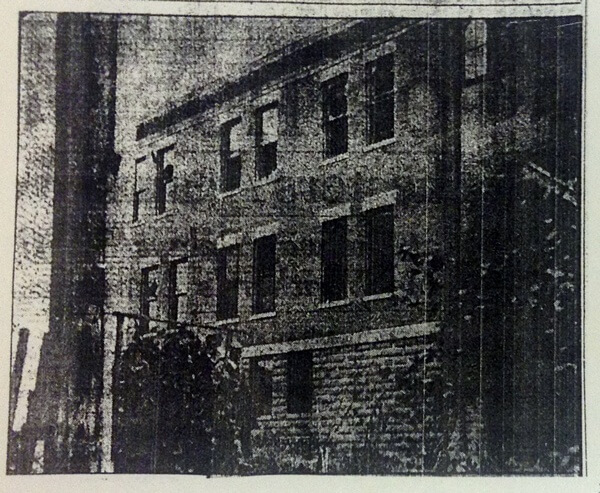
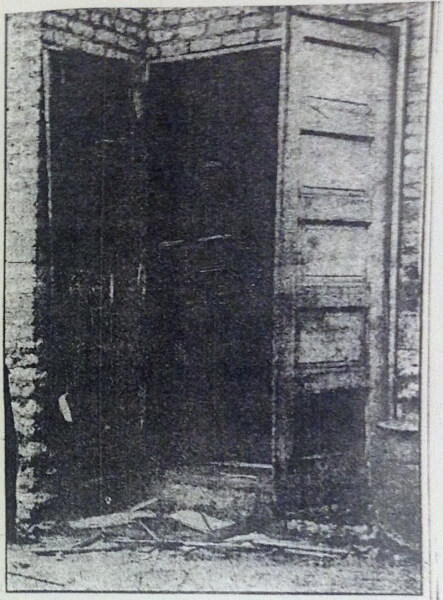
This is what the bomb did at the rear of the Forest theater, 924 East Seventh street, Monday night. The top pictures shows some of the 20[?] windows that were shattered in the rear of the Odd Fellows hall, 724 Reaney street, back of the theater.
The bottom view is a closeup of the rear entrance of the theater, which was shattered and the door blown off its hinges. A recurrence of these conditions is said to be “very difficult if not impossible,” due to extensive precautions taken by police.
Another Bombing
Minneapolis — The Logan, suburban house, operated by W. A. Steffes, Northwest exhibitor unit head, who is directing theaters’ activity in handling the strike of operators, stagehands and musicians, was bombed yesterday. The house was partly wrecked. Bombing followed breakdown of reconciliation efforts instituted Saturday on request of stagehands. The theater outrage follows the recent bombing of the Paramount exchange.
All Negotiations Off in Mpls. Strike
Minneapolis—All negotiations for strike settlement were definitely called off between the Theater Owners Committee and a committee representing local stage hands, operators and musicians. The meeting, held Sunday, could not even reach a point where either side would discuss a contract and realizing the futility of proceeding under the existing conditions, a recommendation was made by two International officers that another meeting be held Monday. Officers feeling that the committees could discuss and possibly reach some basis upon which to negotiate. Sentiment following the bombing of Al Steffes’ Logan theater late Sunday night practically ended all negotiations between the committee. The theater owners committee now refuses to deal with any body except international officers, positively refusing to negotiate with local unions.
Monday night, while running with a full house, the Forest, and F. & R. St. Paul suburban house was bombed but the explosion spent itself on the outside, with only slight damage.
This latest bombing has made the situation even more acute. The same evening a girl was severely burned about the face when someone squirted an atomizer containing a stench preparation on patrons leaving by a side exist. A Hennepin–Orpheum striking stage hand was later arrested and identified as the perpretrator [sic] and at the preliminary hearing next morning was bound over until Thursday after pleading not guilty.
Police protection has been doubled for all theaters in Minneapolis, with an officers stationed in front and in the rear twenty-four hours. The Minneapolis police chief authorized a reward offer of $10,000 for information resulting in the conviction of bombers. Extra precautions are being taken to protect the public against stench bombs.
Business is suffering in suburban houses, but downtown houses are at normal.
What Other People Think
Children or Theaters
To the Editor of The Journal:
I notice that our policemen are asked to work extra hours that all theaters may be provided with guards to prevent bomb throwing. I have also been informed that traffic men are to be taken from street intersections adjacent to schools. I am obliged to remain at home with the younger child, and can not take my children to and from school. I know with what fears my mind will be harrassed [sic] these next few days, not that the protection formerly given my boy and girl has been withdrawn. Let the theaters supply and pay for their own guards against the bombers, and do not take police protection from small children.
— Mrs. C. Orwin, Minneapolis.
[…]
Guard the Children
To the Editor of The Journal:
I believe it was a most injudicious act to take the police away from the school crossings in order to guard the theaters of Minneapolis. The average motorist gives little consideration to the pedestrian crossing the street. It is dangerous for an adult. How much more dangerous is it, then, to a child of five or dix endeavoring to cross a busy street when the traffic is whirling by?
I am personally fond of the theaters and fond of motoring, and also am a father. I believe that any father who is a movie fan places the life of his child ahead of his attendance at the shows. It is not necessary to attend shows, but both the law and good citizenship demand that we send our children to school.
Recently my own son, a boy of six, was 45 minutes late getting home from school. He finally came home with tears in his eyes, saying that he could not get across the street, and finally had piced up courage enough to go into a store and ask the storekeeper to take him across.
It seems as though in this day and age, human life and public morals are lost in the shuffle for the benefit of that time old economic institution called property.
— J. R. Ridpath.
Minneapolis.
Anti-Labor Forces Plot Defeat
Anti-Labor Elements Resort to Dastardly Acts to Force Breakup of Conference Promising Satisfactory Agreement
The latest development in the strike of the theater workers is the rejection of the proposition made to them by the managers. At a joint meeting in Minneapolis Thursday night, called for the purpose, the proposition was decisively defeated. This was no surprise as it was designed to be rejected.
Representatives of the managers and strikers had held a number of conferences last week and on last Sunday evening at 7:30, when the conference adjourned, all but three points had been settled and these promised an early and easy adjustment. When the St. Paul representatives appeared Monday to resume the conference they were told all negotiations were off on account of the bombing of the Logan theater in Minneapolis.
This was a shock to the strikers’ committee as it looked like everything was going to end happily. Then events began to happen that put a new phase on the matter. Immediately a demand was made for police protection and a great show of terror was affected. A special hearing was had by the Minneapolis city council in response to the demand for police protection. The St. Paul police authorities have absolved the stage employees from responsibility for the explosion in St. Paul and have taken no steps to place extra police on duty.
Now comes the real explanations for the breakup of the conference. The managers made a proposition to the strikers radically different from the basis upon which the joint conferences worked. A cut in the number of employees and a drastic reduction in the wages all along the line were demanded in the offer of the managers and which was rejected at the meeting Thursday evening.
The entire proceedings look extremely suspicious and the belief is advanced that some among the managers are working with outside forces to prolong the strike and prevent an amicable settlement.
That some foe of the theater workers’ unions and the labor movement has placed an obstacle in the way of an early and amicable settlement of the trouble with the theater mangers and caused terror to persons and great damage to property at a show house in Minneapolis, managed by Mr. Steffes, chairman Theater Managers’ association, and at a motion picture house on Forest street in St. Paul during the past week. During the previous week bombs were exploded in Minneapolis.
These occurrences are viewed with keen regret and resentment by the committee in charge of the strike; they have done much to prevent possibilities of an early adjustment. It was reported that the managers’ representative declared that negotiations would cease until these outrages stopped. While this is not a direct accusation against the strikers, it is an implication that they have the power to prevent violence.
Employees Against Violence
By what process of reasoning it can be even remotely inferred that the strikers should participate or condone such infamous actions as exploding bombs in or near a theater is difficult to explain. It would not only be folly as it would have the effect of destroying the road to a peaceful settlement; but it might mean the death of many persons who would be innocent of any connection with the matter in controversy.
In addition to the stage employees there are several hundred sympathizers involved in the trouble, and the latter are desirous of a settlement. It is scarcely probably that they would permit violence to be employed in the case.
International Representative on Scene
International representatives are in the Twin Cities endeavoring to adjust the difficulty, and the use of terrorism militates directly against their efforts. From the side of the strikers they have everything to lose and nothing to gain by violent tactics. Certainly the issue is not so desperate that strikers could be goaded to such a futile and dastardly extreme.
The newspapers reported that Mr. Steffes, of the Managers’ association, declared all negotiations off until the use of violence ceased! This was an insinuation that the strikers were responsible for the bombings and were in a position to call a halt. With negotiations under way and a settlement in prospect, what possible motive could their be to resort to such ruthless conduct.
Who Wants Strike Prolonged?
By all principles of reason, it would be those who wanted to prevent a settlement that would explode bombs. Does Mr. Steffes know who is interested in prolonging the strike and why does he not go after them? It certainly is not the strikers. Such being the case, why did he jump to the unwarranted conclusion to break off negotiations until the bombing stopped, and is he playing into the hands of a confederate?
But there are persons in St. Paul who do not want to see this strike amicably settled, and they will resort to every infamous trick to accomplish their end. These are the trouble makers who thrive on industrial strife. The way in which these bombings have been carried out indicates quite clearly that there is something akin to fakery in connection with them. A short time ago a bomb was exploded in Minneapolis in a motion picture theater where there was a strike and the perpetrator had a known motive to discredit the strikers.
The Agent Provocateur
This is an old trick of the anti-labor forces; they either explode bombs or have someone get inside the union and then have him do the trick from the inside. The most famous case was that at the Lawrence, Mass., textile strike, where Woods, president of the woollen [sic] mills, authorized the placing of bombs so as to involve the strikers.
Organized labor has nothing to gain from violence, and when it has to be resorted to it is time for the labor movement to liquidate and go out of business. The enemies of labor know this and try maliciously to fasten such methods on the labor movement.
The strikers are holding their lines solid, and are carrying on an energetic campaign of education among the general public.
All theaters in the Twin Cities are being bannered and are poorly patronized. Some of the downtown show houses are at times visited by out-of-town people, but in the main the attendance is far from fair.
The strikers urge the public to keep away from the theaters until the trouble has been settled. The shows are poor and the fire hazard is great, and the cause of the strikers is just. These are very sound reasons for staying away from the show houses.
New Firm to Handle F.&.R.–Publix Deal
Minneapolis — Stabilized bookings in all of the F. & R. key city houses is assured by the Publix-Northwest Theaters (Finkelstein & Ruben) deal, observes “The F. & R. Showmanship News” in commenting on the new arrangement. A new corporation is to handle the joint affairs of the two exhibiting forces under the deal.
Under terms of the arrangement, the Publix house under construction is placed in the hands of F. & R. and gives F. & R. first call on Paramount product tor the next 25 years. Publix retains a 50 per cent interest in the house it sponsored here, and in six St. Paul houses. In addition, the two arms plan an expansion program in this territory and will be partners in houses built, first of which is the theater under construction at Rochester, Minn.
William Hamm, of the local firm, is to be president of the new company to be formed in the deal. Sam Katz will be vice president, and each organization is to have equal representation on the board of directors.
City Moves to End Minneapolis Strike
Minneapolis — Spurred by outrages which make necessary police and fire guards at every theater of the city, the council has moved to take a hand in bringing about an end to the strike. A resolution has been passed calling for appointment of five aldermen as a committee to bring theater owners and the strikers together.
William F. Canavan, head of the International Alliance of Theatrical Stage Employes and M.P. Machine Operators, yesterday was scheduled to take personal charge of the situation, in efforts to break the deadlock which has resulted in calling out every union employee in theaters here and at St. Paul.
Meanwhile, business at the theaters is holding up surprisingly well in view of the fact that this city ind St. Paul are regarded as strongholds of radical labor factions.
Strong Efforts Being Made to Break Deadlock in Twin Cities
TK
Twin City Showman, Union Compromise to Settle Strike
Minneapolis—Theater owners made slight concessions and stagehands receded from their main demands yesterday to settle the general theatrical strike in the Twin Cities.
The strike, which lasted six weeks, proving the longest in theatrical history, was settled after a series of conferences lasting from 10 A.M. Tuesday until 4 A.M. Wednesday. W. A. Steffes, Northwest exhibitor unit president; Theatore L. Hays of Northwest Theaters and William Canavan, head of the International Alliance of Theatrical Stage Employes and M.P. Machine Operators, effected the settlement.
Although stage hands were granted an increase they failed in attempt to secure one day’s rest in seven. There will be no segregation of departments which would have meant employing additional men, and theater managers reserve full rights to employ and discharge stage hands.
While stage hands originally requested a one year contract with no wage increase, one day rest virtually meant an increase of $9.63 per week. Under the new agreement stage hands accept a three year contract with two dollars increase for the first year, three dollars the second year, and two dollars increase the third year.
Operators had recently signed a one year contract in which they accpeted a new three year agreement calling for no increase the first year, 2½ per cent the second, and the same for the third year. Musicians return to work with no change in the contract which had recently been negotiated. There is practically no change in working conditions in the new contract with stage hands, nor any in the operators’ new three year agreement.
The majority of crafts will return to work Sunday with some houses putting union men back today. It is estimated that the agreement with stage hands will save from $3,000 to $5,000 a year for legitimate houses.
The strike, which lasted six weeks, was the longest in the history of the theatrical world, and estimated at a cost to the allied crafts of approximately $160,000.00 in business. Both sides expressed complete satisfaction over terms of the new contracts and pickets were immediately removed from in front of theaters.
Theatre Strike Ends
Controversy Closed at 4 A. M. Wednesday, Three-Year Contract Signed for Twin Cities
Managers and Unionists Express Satisfaction with Terms of Settlement
The theatrical strike and lockout in Minneapolis and St. Paul ended at 4 a. m. Wednesday when a three-year agreement granting an increase in wages and no reduction in the size of crews was signed by representatives of the managers’ association and the Theatrical Stage Employes and Motion Picture Operators International alliance. All Twin City theatres which have been involved in the controversy since September 18 will be operating with their former union stage hands, picture operators, musicians, scenic artists, bill posters, and transfer men not later than Sunday.
Five international officers of the Theatrical Stage Employes’ union were present at the peace conference which was in continuous session from 2 p. m. Tuesday until the settlement was reached at 4 a. m. Wednesday. They were W. F. Canavan, international president, and Richard J. Green, general secretary-treasurer, both of New York City; George E. Browne, international vice president, Chicago; E. J. Tinney, Youngstown, Ohio, and Charles Crickmore, Seattle, international representatives.
The conference ended with no bitterness on either side, President Canavan told the Labor Review Wednesday morning. “The settlement is satisfactory,” he said.
Loyal support was given the strikers by the local labor movement and the general public during the life of the controversy. The publicity committee of the theatrical unions issued a statement Wednesday morning in which they expressed their appreciation for the stand taken by Minneapolis citizens.
“The members of the theatrical unions involved in the recent controversy with Minneapolis and St. Paul show house managements wish to thank Twin City organized labor, and the general public for the loyal manner in which our strike was supported,” the publicity committee’s statement reads. “In spite of regrettable happenings around the theatres, which our members were in no cases responsible for, we had the respect, support and good will of the majority of citizens. We deeply appreciate this attitude on their parts, and assure our friends that we shall do our utmost to show our gratitude.
“The strike and lockout is over. We are returning to work with no bitterness in our hearts. We have made substantial improvements in our wages and working conditions and there is no reason why our relations with the managers should not be of the most pleasant nature possible.”
Under the terms of the new contract all stage employes return to work at an increased wage of $2 a week. At the end of the first year of the pact pay will be boosted $3 more a week, and an additional $2 weekly raise will be given at the conclusion of the second year. All theatres will continue to employ the same size crews as were used prior to the strike. While the seven day week continues, the increase in pay will during the third year of the contract amount to a sum of almost equal to the cost of hiring a substitute to enable each man to lay off from work one day out of seven.
Motion picture operators, the majority of whom were locked out shortly after the back-stage employes struck, also received an increase in wages and an extension of their contract for two more years, making it expire on August 31, 1930, the same date as that of the stage employes. The operators’ increase amounts to 2½ per cent each year.
W. A. Steffes, president of the Motion Picture Theatre Owners Association of the Northwest, and Theodore L. Hays, general manager of the Finkelstein & Ruben theatre chain, both expressed satisfaction with the ending of the dispute.
“Like Mr. Steffes and Mr. Canavan, I believe the relations between the men and their employers will be more cordial than ever,” Mr. Hays said. “In addition to the wage schedules, a number of other conditions were improved, several obstacles to harmony removed entirely and a more satisfactory understanding established between the owners and the workmen.”
The news of the strike settlement was applauded in all sections of the Minneapolis labor movement. Members of trade unions have shunned the shows since the inception of the dispute and many of them were making preparations to hold theatre parties next week in celebration of ending the strike.
“I congratulate the theatrical unions and their employers on their success in reaching a satisfactory settlement,” A. T. Evans, president of the Minneapolis Central Labor Union, said. “Both sides showed they were able to sit down around a table and talk over their grievances in a sensible manner and make an amicable adjustment.”
Relief Felt Over Twin City Strike Ending
Minneapolis—Theater patrons of the Twin Cities breathed sighs of relef when announcement was made of the settlement of the general strike and the feeling of security is to be enhances today with return of many union employes, with the balance to resume their duties at the theaters next Sunday.
Ending a period of fear, engendered by bombing of theaters, throwing of stench mixtures in theaters and on patrons, and assault on a non-union operator, the compromise was a welcome one and business is expected to show a decided spurt as a result.
Peculiarly, operation of the theaters over the six weeks’ period with non-union employes, did not materially cut grosses at the various houses. The fact is more surprising, when it is realized that the Twin Cities are strongly unionized, and hot beds of labor radicalism. This is due to the campaign conducted by theater owners in carrying their case to the public. The theatermen had been prepared for a finish fight, and it was not until arrival of William Canavan, head of the international union of stagehands and operators, that any compromise appeared possible.
The unions, it is said, were prepared to extend the strike to every theater of the Orpheum and Pantages circuit, a fact declared to have weighed heavily in the compromise, although the balance of Twin City showmen were ready to “go to the mat” running open shop unless they secured a contract which would give them as “Greater Amusements” here put it, “the undeniable right to run their own business.”
Twin City Strike Ends
The Twin City theatre strike, which started September 17 and lasted 38 days, is at an end.
Five hundred stage hands, motion picture machine operators and musicians went back to their jobs this week as the most extended and costly theatre strike in the northwest came to an end.
W. A. Steffes, president of the Motion Picture Theatre Owners Association of the Northwest, announced the following settlement after theatre owners and strike representative had conferred many times:
A three year contract replaces the former one-year contract with the stage hands, and they are to be paid $2 more per week during the first year of the contract, $3 more for the second year and $2 more the third year, a total increase of $7 a week for the three years.
Picture machine operators also are put under a three-year contract, which replaces their annual agreement. They are to receive no increase the first year, but an increase of 2½ per cent the second year, and 2½ per cent more the third year. Hitherto the St. Paul scale has been slightly lower than the Minneapolis scale, but it will now be equal to it.
The musicians who, with the operators walked out in sympathy when non-union men replaced the stage hands, returned to work with no change in their status.
Steffes expressed his satisfaction with the settlement, as did Theodore Hays, general manager for Finkelstein and Ruben and W. F. Canavan, president of the International Stage Hands Union, who helped with the negotiations.
Steffes said: “Although the settlement cannot be termed a complete victory for either side, the strike has been successful in establishing a better understanding between owners and craftsmen. We are entirely satisfied with the agreement reached, and believe that relations from now on will be more cordial than ever before.
The strike started when the stage hands of Minneapolis and St. Paul demanded one day’s rest in seven. This request was refused by the theater owners, who interpreted it as a demand for seven days’ pay for six days’ work.
Steffes estimated that the strike caused a 10 per cent decrease in theatre grosses during the five weeks. The 58 theatres of Minneapolis probably do a business of about $150,000 weekly, which means that the loss was about $15,000 a week, or $75,000 for the period of the strike in that city alone. The loss, however, was actually much heavier Three theaters and one exchange were bombed during the strike, and the damage done must be reckoned in the total loss; also several thousand dollars which Minneapolis spent hiring emergency policemen to guard the theatres.
Ushers, Minnesota Theater, Minneapolis
Ushers, Minnesota Theater, Minneapolis.
Looking South on Hennepin Avenue from 6th Street
List of motion picture theaters operating in the Twin Cities
Statistics from the Theaters section of The Film Daily Year Book 1928, containing “a complete list of over 20,000 motion picture theaters operating in the United States” for 1927:
| Minneapolis | |
| Population, 434,000 | |
| Theater Address | Seating Capacity |
| Agate, 2225 E. Franklin | 400 |
| Alhambra, 3211 Penn Ave. No. | 300 |
| American, 16 E. Lake St. | 450 |
| Bijou, 20 Washington Ave. N. | 1500 |
| Camden, 4217 Webber Parkway | 350 |
| Cedar, 713 Cedar Ave. | 250 |
| Crystal, 305 Hennepin Ave. | 350 |
| Dewey, 38 Washington Ave. So. | 400 |
| East Lake, 1537 E. Lake St. | 400 |
| El Lago | …. |
| Elite, 2519 27th Ave. So. | 300 |
| Emerson, 2605 Emerson Ave. No. | 350 |
| Empress, 412 W. Broadway | 450 |
| Forest Park | …. |
| Garrick, 40 So. 7th St. | 1600 |
| Glen Lake, 2201 6th Ave. No. | 240 |
| Glenwood Palace, destroyed | 350 |
| Gopher, 1706 4th Ave. So. | 400 |
| Granada | …. |
| Grand, 619 Hennepin Ave. | 1000 |
| Ha-Ha, 3954 Minnehaha Ave. | 350 |
| Heights | …. |
| Hennepin-Orpheum, 910 Hennepin Ave. | 2000 |
| Homewood, 1919 Plymouth Ave. No. | 900 |
| lone, 309 Cedar Ave. | 450 |
| Lagoon, 2906 Hennepin Ave. | 980 |
| Lake, 2721 E. Lake St. | 400 |
| LaSalle, 2541 Nicollet Ave. | 500 |
| Liberty, 1013 6th Ave. No. | 420 |
| Logan, Logan and West Broadway | 650 |
| Loring, 1405 Nicollet Ave. | 600 |
| Lyndale, 2932 Lyndale Ave. So. | 500 |
| Lyric, 711 Hennepin Ave. | 1500 |
| Main, 1029 N. W. Main St. | 350 |
| Mazda, 246 Hennepin | …. |
| Miles Standish, Second Ave. & 38th | …. |
| Minnesota, 9th and La Salle (building) | 3200 |
| New Arion, 2316 Central Ave. N. E. | 650 |
| New Astor, 670 Hennepin Ave. | 900 |
| New Cozy, 405 Plymouth Ave. | 500 |
| New Franklin, 1021 E. Franklin | 800 |
| New Park, 725 So. 10th St. | 400 |
| New Lake, 31 W. Lake St. | 500 |
| New Palace, 5th & Hennepin | …. |
| New Rose, 114 Hennepin Ave. | 300 |
| New Vista, 7th & Cedar | …. |
| Nokomis, 3749 Chicago Ave. So. | 400 |
| Old Mill, 310 Hennepin Ave. | 300 |
| Pantages, 710 Hennepin Ave. | 2000 |
| Princess, 4th St. and E. Hennepin Ave. | 700 |
| Rex, 212 Hennepin Ave. | 350 |
| Rialto, 735 E. Lake St. | 600 |
| Rosebud, 1506 E. Lake St. | 300 |
| Savoy, 242 Hennepin Ave. | 350 |
| Seventh St., 21 S. 7th St. | 2000 |
| Southern, 1422 Washington Ave. So. | 650 |
| State, 801 Hennepin Ave. | 2750 |
| Strand | 1100 |
| Stockholm, 103 Washington Ave. So. | 320 |
| Strand, 37 S. 7th St. | 1200 |
| Unique, 520 Hennepin Ave. | 800 |
| University, 1308 S. E. 4th St. | 400 |
| Vista, 727 Plymouth | …. |
| Wonderland, 27 Washington Ave. So. | 400 |
| St. Paul | |
| Population, 248,100 | |
| Theater Address | Seating Capacity |
| Alhambra, 16 E. 7th St. | 400 |
| Arcade, 947 Arcade St. | 300 |
| Astor, 449 Wabasha | 1100 |
| Blue Bird, 902 Rice St. | 300 |
| Capitol, 7th and St. Peter | 2375 |
| Concord, So. Robt. & Concord | …. |
| Cozy, 389 W. 7th St. | 300 |
| Dale, 635 Selby Ave. | 700 |
| DeLuxe, 287 Maria Ave. | 400 |
| Empress | …. |
| Faust, 624 University Ave. | 400 |
| Forest, 924 E. 7th St. | 500 |
| Garden, 929 W. 7th St. | 450 |
| Garrick, 6th and St. Peter | 1200 |
| Hamline, 1533 University Ave. | 400 |
| Ideal, So. St. Paul | 350 |
| Liberty, 135 Eaton St. | …. |
| Mohawk, 629 So. Smith Ave. | 600 |
| Mound, 1029 Hastings Ave. | 400 |
| New Francis, E. 7th St. | 205 |
| New Ray, 179 E. Fairfield Ave. | 300 |
| New State, E. 7th St. | 400 |
| Orpheum, 5th & St. Peter | …. |
| Oxford, Grand and Oxford St. | 1000 |
| Palace Orpheum, 7th and Wabasha | 1400 |
| Palace, 108 Concord St. | 600 |
| Princess, 19 E. 7th St. | 900 |
| Park, 1595 Selby Ave. | 1000 |
| Regent, 436 Wabasha | 300 |
| Radio, 1195 E. 7th St. | 400 |
| Rialto, North St. Paul | 300 |
| St. Clair, Snelling and St. Clair St. | 1200 |
| Shubert, Exchange and Wabasha | 800 |
| Strand, 440 Wabasha | 750 |
| Summitt, 391 Selby Ave. | 300 |
| Tower, 438 Wabasha | 1000 |
| Venus, 1077 Payne Ave. | 400 |
| Verdi, 302 University Ave. | 300 |
Staff Women Polishing a Chandelier at the Minnesota Theater
Plea by Theatre Owners
SEATTLE, July 14 (AP).—Independent motion picture theatre owners will meet in Chicago next October to demand that the group of producers and distributers of which Will H. Hays is national head allow them more favorable exhibiting conditions.
This was announced here today by W. A. Steffes, President of the Motion Picture Theatre Owners of the Northwest and the Exhibitors Allied States Association.
“We will demand,” he said, “that the Federal Trade Commission either accept or reject the recommendation we made at its national conference last Fall, when the film industry got together to work out a code of ethics.”
Their recommendations included a request that the Trade Commission will eliminate compulsory block booking, which compels a theatre to take the output of one producer for a year. The independents, Steffes said, wish to keep the producers out of theatre ownership to a degree sufficient to insure that they could not “hold a club over the independents.”
Stage of the Granada Theater at 3020 Hennepin Avenue
Front of the Granada Theater at 3020 Hennepin Avenue
Marquis says that the theater will open soon with “Vitaphone and Movietone” to accommodate sound pictures. Only theater itself is visible on the print. Other business are visible only on the 8×10 negative.
Aster Theater hallway
Aster Theater, 607 Hennepin Avenue, Minneapolis.
Aster Theater auditorium
Key City Grosses (1929) — Minneapolis and St. Paul Theaters
Aster Theater lobby
Aster Theater, 607 Hennepin Avenue, Minneapolis.
Minnesota Theater, 36-40 Ninth Street South, Minneapolis
Publix–F. & R. Deal Is Climax of Long Parleys
Minneapolis—Closing of the Paramount deal for acquisition of Publix brings to an end negotiations for the circuit by various interests extending over a period of years. Paramount, Fox, Warners are reported to have sought purchase of the chain at various times.
Eighteen months ago, it appeared practically certain that the chain would be sold to Fox. Negotiations had been carried on over a period of weeks, reputed to have been $9,000,000, was agreed upon and William Hamm and M. L. Finkelstein went to New York to close the deal. A last minute hitch, said to have been over terms of financing the transaction, prevented consummation.
At the time the First National deal was on a year ago. Warners are understood to have made an offer for the circuit but no deal was made.
Several months ago, when Publix began its campaign to buy out holdings of its partners, the F. & R. circuit was one of the first objectives. A survey of the chain was made recently by Fred Greene, following which two weeks ago M. L. Finkelstein and Eddie Ruben came to New York, where they were joined by William Hamm, to close the deal.
Shubert Theater, 20-22 North Seventh Street, Minneapolis
Aster Theater, 605-607 Hennepin Avenue, Minneapolis
Palace Theater, 414 Hennepin Avenue, Minneapolis
Nokomis Theater, 3749 Chicago Avenue, Minneapolis
View from the side aisle of the auditorium, balconies and ceiling of the Orpheum Theater, Minneapolis
Children standing outside the Minnesota Theatre, 36-40 Ninth Street South, Minneapolis.
Partial view of the auditorium and lower portion of the balcony of the Orpheum Theater, Minneapolis
Logan Sweet Shoppe and a movie theater, 2027 West Broadway, Minneapolis
Finkelstein & Ruben and managers of the Finkelstein & Ruben chain of movie theaters
Metropolitan Theater, 320 Marquette, Minneapolis
View of the box office lobby of the Orpheum Theater, Minneapolis
Leonard Leigh, organist at the Paramount Theater
View of a hallway in the Orpheum Theater, Minneapolis
Hennepin Avenue between Eighth and Ninth Streets, Minneapolis
Hennepin Avenue between Eighth and Ninth Streets, Minneapolis; State Theater at center.
Eddie Dunstedter at organ, Minnesota Theater
Eddie Dunstedter at organ, Minnesota Theater.
Diagonal view from across the street of the Orpheum Theater, Minneapolis
Ushers at the State Theater, Minneapolis
Ushers at the State Theater, Minneapolis.
Setting revolving stage at Metropolitan Theater, 320 Marquette, Minneapolis
Setting revolving stage at Metropolitan Theater, 320 Marquette, Minneapolis.
Setting revolving stage at Metropolitan Theater, 320 Marquette, Minneapolis
Stores damaged by a bomb intended for the Falls Theater
Stores adjoining the Falls Theater, 3954 Minnehaha Avenue, damaged by a bomb intended for the theater, Minneapolis.
The Cozy Theater on Plymouth Avenue North After a Bomb Exploded
Uptown Theater, Minneapolis, Minnesota
Uptown Theater, Minneapolis, Minnesota
Uptown Theater, Minneapolis, Minnesota
View from across the street of the old façade and marquee of the Uptown Theater, Minneapolis, Minnesota, before remodeling. Liebenberg and Kaplan, Architects (1919-1969), were noted for designing more than 200 motion picture theatres in the Upper Midwest, many of the early ones featuring an art deco style.
Minnesota Theater, 36-40 Ninth South, Minneapolis
Looking North on Nicollet Avenue from 11th Street
Century Theatre, 38 South Seventh, Minneapolis
Street scene. Minneapolis, Minnesota
Time Theater, 729 Hennepin, Minneapolis
Paradise Theater, 2027 West Broadway, Minneapolis
Paradise Theater, 2027 West Broadway, Minneapolis.
Bijou Theatre, 20 Washington Avenue North, Minneapolis
Uploaded to Cinema Treasures by Chris1982.